

| Contents |
| Quick Comparison Table 1. Structural Comparison 2. Usage Comparison 3. Performance Comparison 4. Security Features 5. Why Choose SINOHENG? 6. Conclusion |
| Discover More Options |
Flatbed semi trailer and low bed trailer look somewhat similar, both featuring open large flat platforms, so many people are unsure about the differences between these two types of semi-trailers.
Today, SINOHENG will compare the structural, functional and performance differences between these two trailers, offering practical guidance to support your selection process.
Now, let’s begin.
Quick Comparison Table
To assist your decision, SINOHENG has prepared a comparison table outlining the key differences between flatbed semi trailer and lowboy semi trailer in structure, applications, performance and safety.
| Name | Structure | Purpose | Performance | Safety |
| Flatbed Semi-trailer | Open-platform design with no fixed sides or partitions enables loading and unloading from any direction. Its through-beam chassis is built with a moderate web height for balanced strength and weight. | The most core universal tool in the global transportation industry; high versatility; suitable for long-distance transport; good road surface adaptability. | Suitable for transporting large, heavy cargo with strong load-bearing capacity; suitable for long-distance transport with high efficiency and stable performance even during prolonged operation. | The support beams on the upper part of the frame provide better reinforcement, making it relatively more stable and safer. |
| Lowboy Semi-trailer | Drop-deck (or well-type) frame, low-center-of-gravity design, main cargo deck plane is low; front part is gooseneck, middle is cargo platform (lowest part of frame), rear is wheel carriage. | Suitable for transporting large, heavy, and non-disassemblable goods, such as excavators; stronger road surface adaptability. | Low center of gravity makes transporting tall cargo more stable, especially suitable for oversized goods; stronger adaptability to complex road conditions. | Relatively simpler design, robust structure, usually has a longer service life than flatbed semi-trailers. |
Structural Comparison
1. Flatbed Semi Trailer
· Open platform design without fixed sides or dividers, enabling loading and unloading from almost any direction.
· Constructed with high-strength carbon steel main beams and advanced manufacturing techniques, including robotic welding, anti-rust sandblasting, and two-layer painting, to ensure strength and long-term durability.
· The chassis features a through-beam structure with appropriately sized web plates.
· Key components—such as axles, suspensions, tyres, and braking systems—are sourced from leading international and domestic brands (e.g. FUWA, BPW, WABCO), delivering reliable driving stability and braking performance.
· Designed with container locks for transporting one 40-foot or two 20-foot containers.
· Available with 3, 4, or 5 axles, and in load capacities of 40, 60, and 80 tonnes.
· Customisation options include adjusting length, width, axle number, braking system, lighting, electrical connections, and floor type to suit local conditions and operational needs.
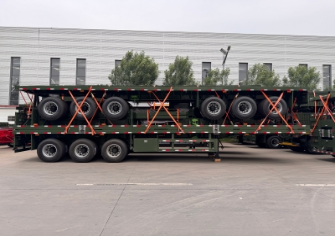
Fresh off the production line, the SINOHENG flatbed semitrailer is now awaiting delivery.
2. Lowboy Semi-Trailer
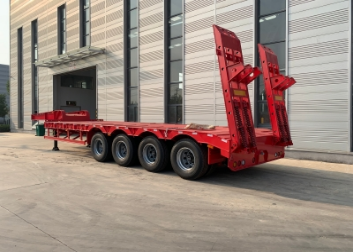
· Features a recessed (well-type) frame with a low centre of gravity and a lowered main platform, increasing load space to accommodate oversized or specialised cargo.
· The frame consists of longitudinal beams, cross members, and supporting structures. It is divided into three sections: the gooseneck at the front, the low-loading platform in the middle, and the wheel carriage at the rear.
· Frame shape and dimensions can be tailored to the specific type of goods being transported.
· Constructed from high-strength carbon steel with reinforced main beams and axles, ensuring durability, strength and high load-bearing capacity.
· Customisation options include adjustments to length, width, number of axles, braking system, lighting, electrical connections, and deck type to suit local operating conditions and customer requirements.
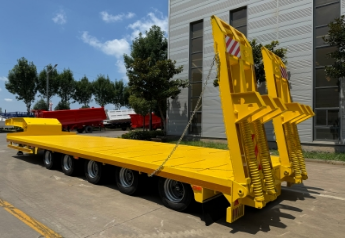
The SINOHENG lowbed semi-trailer has been completed and is now ready for delivery.
Usage Comparison
1. Flatbed Semi-Trailer
· A versatile and essential solution in global freight transport.
· Well-suited for irregularly shaped and heavy loads.
· Ideal for long-haul operations.
· Commonly used in engineering, manufacturing, logistics, and energy sectors.
· Capable of handling a variety of road conditions.
2. Lowbed Semi-Trailer
· Designed for oversized, heavy, and non-demountable cargo.
· Typically transports engineering machinery, wind turbine components, large tanks, vessel sections, and bridge structures.
· Suitable for both urban and highway use, particularly in long-distance heavy haulage.
· Offers enhanced performance over flatbeds on challenging or complex routes.
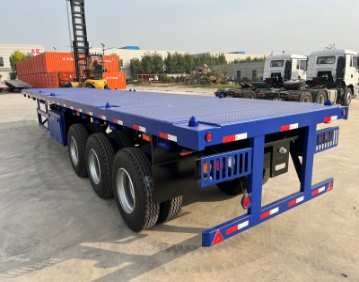
A leading Chinese semi-trailer manufacturer, SINOHENG supplies markets in over 40 countries globally.
Performance Comparison
1. Flatbed Semi-Trailer
· Offers high load capacity, making it suitable for large, heavy goods.
· Designed for long-distance haulage, delivering efficient and stable performance over extended periods.
· Fitted with premium branded components (e.g., FUWA, BPW, WABCO axles, suspension, tyres, and braking systems) for enhanced driving stability and braking performance.
· Note: The open design requires careful attention to load height due to the lack of side restraints.
2. Lowbed Semi Trailer
· Its low-centre-of-gravity design provides superior stability, especially for tall or oversized cargo.
· Specifically engineered for super-sized loads like construction machinery, wind turbine components, large ship sections, and bridge structures.
· The lower deck height allows for the transport of taller equipment, such as heavy vehicles and plant machinery.
· Combines exceptional load-bearing capacity (with certain models rated up to 40 tonnes) with an optimal balance between tare weight and payload.
· Offers better performance on complex or demanding road surfaces compared to flatbed trailers.
SINOHENG is your reliable semi-trailer supplier in China.
Security Features
1. Flatbed Semi-Trailer
· An upper frame support bar provides added reinforcement, contributing to overall stability.
· Available with optional safety systems such as ABS to improve control during braking.
· For mountainous terrain, SINOHENG trailers feature an optimised braking system that meets safety standards for stopping distance.
2. Lowbed Semi-Trailer
· Critical structures like the main beam are reinforced (e.g., with a double parabolic inner arc) to minimise fracture risk.
· Fitted with high-quality axles from reputable manufacturers.
· Comes equipped with an ABS anti-lock braking system as standard for enhanced safety.
· The robust yet straightforward design generally ensures a longer service life compared to flatbed trailers.
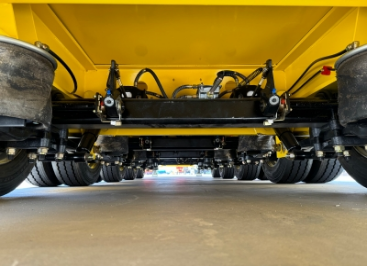
SINOHENG priority quality components, with a sturdy and durable chassis, are highly praised!
Why Choose SINOHENG
· A top-three semi-trailer manufacturer in China, SINOHENG brings over 14 years of design and manufacturing expertise.
· Every trailer undergoes rigorous quality checks, complies with international transport standards, and holds ISO and CE certification — guaranteeing robust, durable and reliable performance.
· Our products are exported to more than 40 countries and regions, having earned consistent praise from customers worldwide.
· We offer fully customisable solutions, including adjustments to length, width, axle count, braking systems, lighting, electrical interfaces, and flooring — tailored to your local operating conditions.
· Comprehensive after-sales support is provided, covering operator training, maintenance assistance, and export clearance guidance.
Conclusion
As outlined above, flatbed semi trailer and lowbed semi trailer each serve distinct roles and applications. Your choice should align with your specific transport requirements.
Should you have special needs, SINOHENG can provide in‑depth customisation to match your actual operating conditions.
For further advice or consultation, please do not hesitate to contact us. We are ready to offer you professional and timely support.
Discover More Options
Want to learn more about product options?
Take a look at our carefully selected products and find the product type that best suits your needs:
If you’d like to explore further, please read the following recommended articles. I believe you’ll find them very helpful:
· How to distinguish the advantages and disadvantages of chassis protection?
Still haven’t found what you’re looking for?
Please contact us immediately—we’re here to assist you 24/7.